An AI contact center uses artificial intelligence to help customers get answers faster and help agents resolve issues more accurately. Instead of treating every interaction like a brand-new case, AI can recognize intent, surface relevant knowledge, automate routine steps, and summarize conversations in real time. The result is a contact center that can scale support without scaling complexity.
Modern AI in the contact center typically includes conversational AI (chatbots and voice bots), agent assist (real-time guidance), workflow automation, and analytics that turn conversations into actionable insights. When implemented thoughtfully on an omni channel contact center, these capabilities can improve customer satisfaction, reduce wait times, lower costs per contact, and create a smoother day for agents. This approach highlights AI contact center engagement strategies.
To fully realize these benefits, organizations should carefully evaluate AI contact center pricing as part of their broader transformation plan. Pricing models may reflect platform access, advanced AI modules, usage thresholds, or outcome-based metrics tied to automation performance. Understanding how costs evolve as adoption grows—across channels, geographies, and customer segments—helps ensure scalability without compromising budget predictability. With clear pricing visibility, leaders can confidently invest in AI initiatives that balance innovation, efficiency, and long-term business value.
What “AI contact center” actually means
An AI contact center is not a single tool. It is a set of capabilities layered across your existing channels (phone, chat, email, messaging, and social) and integrated with systems like CRM, ticketing, and knowledge bases. This approach highlights the value of contact center artificial intelligence in improving both efficiency and customer experience.
In practice, AI can support:
- Self-service via chatbots or voice bots for common questions and simple transactions
- Agent assist that suggests answers, knowledge articles, and next-best actions during live conversations
- After-call work automation such as summaries, dispositions, and follow-up drafts
- Quality management with automated conversation scoring and topic detection
- Insights and forecasting by analyzing reasons for contact, sentiment, and emerging issues
The best AI programs prioritize measurable customer and agent outcomes rather than novelty, creating tangible improvements. This is why deploying ai for contact center solutions thoughtfully—defining human oversight, selecting reliable use cases, and building consistent workflows—is so important.
Why businesses adopt AI contact centers
1) Faster resolution and reduced wait times
AI can handle high-volume, repeatable requests instantly (for example, password resets, order status, appointment reminders, or basic account updates). By deflecting or resolving these contacts, your queues shrink and your live agents can focus on more complex needs.
In live interactions, agent assist can also speed up handling by providing:
- Relevant knowledge suggestions based on the customer’s issue
- Structured troubleshooting steps
- Auto-filled forms and guided workflows
- Drafted responses that agents can edit and approve
2) More consistent customer experiences
Consistency is hard when different agents interpret policies or search for answers differently. AI can help standardize responses by grounding suggestions in approved knowledge and policy content, making it easier to deliver uniform service across shifts, sites, and languages.
3) Better agent experience and lower burnout
Contact center work is demanding, especially with growing volumes and channel complexity. AI reduces repetitive work by automating routine documentation, surfacing context, and handling simple questions. This can lead to more meaningful conversations for agents and a more manageable workload.
4) Cost efficiency without sacrificing quality
Cost savings typically come from a combination of higher containment in self-service, reduced average handle time, and less manual after-contact work. AI can also reduce rework by improving accuracy and ensuring the right steps are followed.
5) Real-time insights that drive business improvements
Customer conversations contain valuable signals: product friction, billing confusion, delivery issues, policy gaps, and more. AI analytics can categorize and summarize these themes at scale so operations, product, and marketing teams can address root causes, reducing future contact volume. This demonstrates why ai for contact centers is becoming essential for modern service organizations and why selecting the right ai contact center software is critical for lasting impact.
Top AI Contact Center Solutions Transforming Customer Service
AI contact centers are revolutionizing the way businesses handle customer interactions. By combining artificial intelligence with cloud technology, these platforms automate routine tasks, improve agent performance, and deliver personalized, efficient customer experiences. From intelligent routing to virtual agents and real-time analytics, AI contact centers are helping companies reduce costs and boost satisfaction. Here are the leading AI contact center solutions today:
1. Bright Pattern — Best Overall AI Contact Center Solution
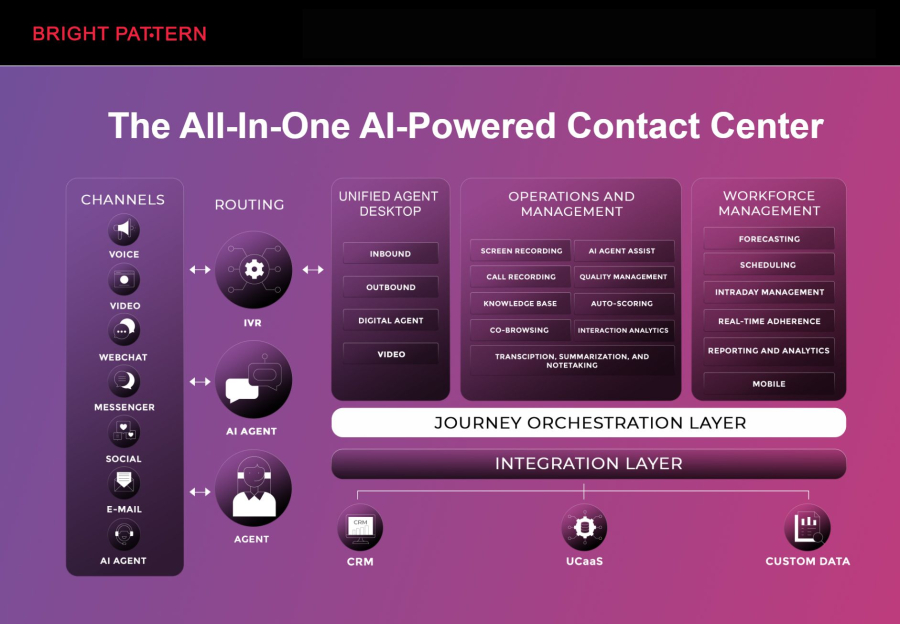
Bright Pattern is a comprehensive AI contact center platform that combines intelligent automation, real-time agent assistance, and omnichannel communication in a single platform.
Key Features:
- AI virtual agents handle FAQs, order tracking, appointment scheduling, and basic support inquiries automatically.
- Intelligent routing connects customers with the right agent based on skills, sentiment, and interaction history.
- Omnichannel support ensures seamless service across voice, chat, email, SMS, and messaging apps.
- Real-time agent assist suggests next-best actions, responses, and knowledge base articles to agents during interactions.
- Analytics and insights monitor customer interactions in real-time and provide actionable insights for improvement.
- Scalable and secure platform with configurable workflows and enterprise-grade compliance.
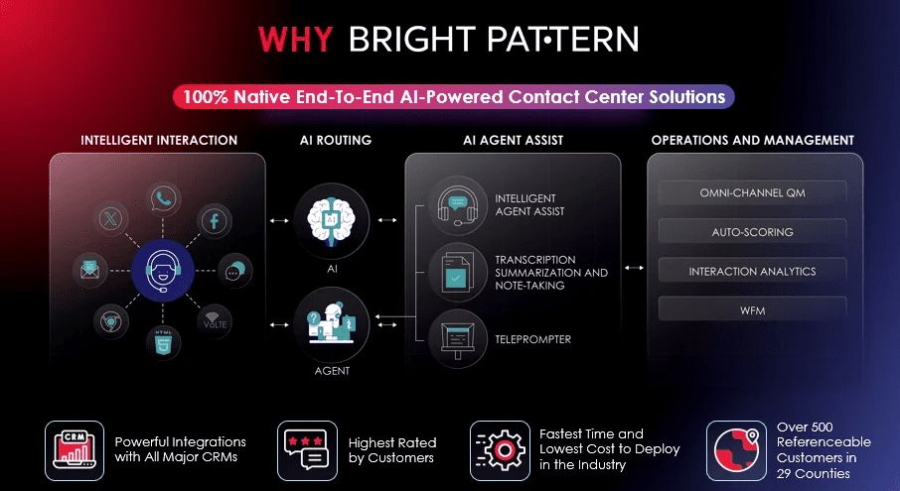
Bright Pattern helps businesses reduce call handling time, improve first-call resolution, and deliver consistent, human-centric experiences across every channel. Its AI-driven capabilities make it ideal for modern, customer-focused organizations.
2. Genesys Cloud CX
Genesys Cloud CX leverages AI to provide predictive engagement, intelligent routing, and real-time customer journey analytics, helping organizations deliver proactive and personalized customer service.
3. NICE CXone
NICE CXone uses AI for workforce optimization, automation, and customer interaction analytics. Real-time sentiment analysis helps improve agent performance and overall customer satisfaction.
4. Talkdesk AI
Talkdesk AI offers virtual agents, real-time guidance, and automated workflows, enabling faster response times and scalable support for growing contact centers.
5. Amazon Connect
Amazon Connect integrates AI technologies such as Amazon Lex and Contact Lens to provide virtual agents, speech recognition, and sentiment analysis, creating a scalable, cloud-native contact center experience.
6. Zendesk AI
Zendesk AI enhances customer support with conversational bots, AI-assisted responses, and knowledge base recommendations, helping teams deliver accurate and fast solutions.
7. Microsoft Dynamics 365 Customer Service
Microsoft Dynamics 365 integrates AI with CRM systems to deliver virtual agents, predictive insights, and real-time guidance, enabling smarter, more efficient support.
8. Google Cloud Contact Center AI (CCAI)
Google CCAI provides AI-powered virtual agents, speech-to-text analytics, and real-time agent assistance, making it highly flexible for businesses requiring custom solutions.
9. Salesforce Service Cloud + Einstein AI
Salesforce Einstein enhances Service Cloud with AI-driven case routing, predictive recommendations, and automated workflows, optimizing agent efficiency and customer experience.
10. Five9 Intelligent Cloud Contact Center
Five9 offers AI-powered virtual agents, smart IVR, and agent assist tools, helping organizations transition from traditional call centers to modern AI contact center environments.
Core AI contact center capabilities (and what they do best)
| Capability | What it does | Best for | Common outputs |
|---|---|---|---|
| Conversational AI | Understands customer intent and responds in chat or voice | High-volume, repeatable questions and simple workflows | Answers, form collection, routing, transactional actions |
| Intelligent routing | Matches customers to the right agent or queue | Reducing transfers and improving first-contact resolution | Skill-based assignment, priority signals, context handoff |
| Agent assist | Suggests knowledge and next steps during live interactions | Complex issues, policy-heavy support, new agent ramp-up | Suggested answers, checklists, summaries, compliance prompts |
| Automation | Executes workflows across CRM, ticketing, and back-office systems | Reducing manual steps and errors | Auto-updates, ticket creation, follow-up tasks, notifications |
| Conversation analytics | Finds patterns and insights in interactions | Quality, VOC (voice of customer), root-cause analysis | Topic trends, sentiment signals, QA scoring, compliance flags |
High-impact AI contact center use cases
Self-service that customers actually want to use
Customers generally prefer self-service when it is fast, accurate, and easy to escape to a human if needed. AI improves self-service by understanding natural language, asking clarifying questions, and completing simple tasks rather than only pointing to a help article.
Strong self-service candidates include:
- Order status and delivery updates
- Password resets and account access help
- Billing and payment questions (where policy allows)
- Appointment scheduling and changes
- Basic troubleshooting and how-to guidance
Agent assist that boosts confidence and quality
Agent assist can listen (or read) in real time and recommend relevant information. Done well, it functions like a smart copilot: agents remain in control, but they no longer have to hunt across tabs for the right answer.
Typical benefits include faster ramp-up for new hires, fewer escalations, and more consistent compliance with scripts and policies.
Automatic summaries and reduced after-contact work
After-contact work (ACW) quietly consumes time. AI-generated summaries can capture the reason for contact, steps taken, outcomes, and follow-ups. Agents can quickly review and edit, then save. This speeds throughput and improves record quality.
Proactive support and outbound notifications
AI can help you move from reactive to proactive by detecting patterns (for example, rising errors after a release) and triggering outreach (such as status updates or guidance). Proactive contact reduces inbound volume and improves trust by keeping customers informed.
Quality monitoring at scale
Manual QA sampling reviews only a small portion of interactions. AI can expand coverage by flagging calls or chats that contain specific risks, policy moments, or customer frustration signals. Supervisors can focus attention where it matters most, and coaching becomes more targeted.
What success looks like: outcomes to aim for
A successful AI contact center program usually improves a set of operational and experience metrics, not just one. The most common outcomes include:
- Higher containment for straightforward requests, with safe escalation paths
- Lower average handle time (AHT) without reducing quality
- Improved first contact resolution (FCR) through better routing and agent guidance
- Higher customer satisfaction (CSAT) from faster, more accurate support
- Reduced transfer rate due to intent recognition and skill matching
- Lower ACW via automated summaries and ticket updates
- Stronger compliance with policy prompts and consistent messaging
Importantly, these improvements tend to compound: fewer transfers improve FCR, better FCR improves CSAT, and lower ACW increases capacity during peak periods.
How to implement an AI contact center (a practical roadmap)
Step 1: Start with 2 to 3 specific, measurable use cases
Choose use cases where:
- Intent is clear and repeatable
- Policy is stable enough to encode in knowledge
- Success can be measured with existing data
- Escalation to a human is straightforward
Examples include automated order status, password reset support, and agent assist for a top call driver.
Step 2: Prepare knowledge and content for accuracy
AI is only as helpful as the information it can rely on. Consolidate and clean your knowledge base, then align it with the language customers use. Clear, well-structured articles improve both self-service outcomes and agent assist relevance.
Helpful content upgrades include:
- Short, task-based articles with explicit steps
- Decision trees for common troubleshooting paths
- Policy snippets written in plain language
- Consistent naming of products, plans, and features
Step 3: Design for human control and safe escalation
For customer-facing bots, define when to hand off to a human (for example, authentication failures, repeated misunderstandings, or high-value accounts). For agent-facing AI, keep agents in control with review-and-approve workflows for suggestions and summaries.
Step 4: Integrate with your systems of record
AI becomes dramatically more useful when it can access the right context and trigger the right workflows. Typical integrations include CRM, ticketing, order management, identity and access management, and knowledge systems.
Even with integrations, many organizations start with a “read-first” approach (surface context and suggestions) before enabling “write” actions (updating records, initiating refunds, or changing account settings).
Step 5: Pilot, measure, and tune
Run a pilot with clear success criteria and a defined period for tuning. Focus on intent coverage, containment quality, escalation rate, and agent adoption. Use transcripts to find where customers get stuck and refine prompts, knowledge, and routing.
Step 6: Operationalize with governance and coaching
AI in the contact center is not “set and forget.” Establish ownership across operations, IT, security, and knowledge management. Provide agent coaching so the team understands when to trust AI suggestions, when to verify, and how to improve outcomes with feedback loops.
KPIs to track in an AI contact center
Tracking the right metrics keeps your AI program grounded in outcomes. Consider measuring:
- Containment rate (percentage of contacts fully handled by self-service)
- Escalation rate and handoff quality (did the agent receive context?)
- Average handle time (AHT) and after-contact work (ACW)
- First contact resolution (FCR)
- Transfer rate
- CSAT and, where used, NPS
- Quality scores (manual plus automated indicators)
- Agent adoption (usage of assist features) and agent satisfaction
- Cost per contact and contact rate per customer segment
For best decision-making, pair speed metrics with quality metrics. Faster is only a win if issues are resolved correctly and customers feel supported.
Building trust: privacy, security, and compliance considerations
Trust is a growth multiplier in customer support. Strong AI contact center programs typically address:
- Data minimization: capture only what is needed for support outcomes
- Access controls: ensure AI and users only access appropriate customer data
- Retention policies: align transcript and recording retention with legal and operational needs
- Auditability: log actions taken by automation and changes to knowledge content
- Customer transparency: clearly indicate when customers are interacting with automated systems
If you operate in regulated industries, involve compliance early to define which workflows are acceptable for automation, what disclosures are required, and how to handle sensitive data and authentication.
Choosing the right AI contact center approach
There are multiple ways to adopt AI, and the right choice depends on your stack, scale, and maturity. When evaluating solutions, look for strengths in:
- Channel coverage (voice and digital) aligned with your customer mix
- Knowledge integration and tools for continuous content improvement
- Configurable routing and clear escalation controls
- Agent experience, including low-friction UI and actionable suggestions
- Analytics that connect conversation themes to operational actions
- Security features and administrative governance
- Deployment flexibility and integration support for your systems
A practical way to compare options is to run the same pilot use case across solutions and score them against your KPIs, implementation effort, and the quality of agent and customer experiences.
Quick-start checklist for an AI contact center rollout
- Pick a top call driver that is repeatable and measurable.
- Clean and structure knowledge so answers are current and task-focused.
- Define escalation rules to protect customers and brand experience.
- Integrate key context (customer identity, order status, ticket history) where feasible.
- Launch a pilot with clear success targets and a tuning plan.
- Train agents and supervisors on how to use AI effectively and provide feedback.
- Measure and expand to the next use cases once results are stable.
The bottom line
An AI contact center helps you deliver the kind of support customers value most: fast answers, accurate resolutions, and smooth handoffs when human help is needed. For your team, it can reduce repetitive work, improve consistency, and create more capacity without compromising quality.
Start with a few high-impact use cases, invest in great knowledge content, and measure outcomes relentlessly. With that foundation, AI becomes a durable advantage: better experiences, more resilient operations, and a contact center ready to scale with your business.
